

I believe that the integration between HCL Domino and Artificial Intelligence engines represents one of the most significant innovations of recent years.
Having an interface to the AI world directly from HCL Notes mail or from another desktop application opens up extremely interesting scenarios, allowing advanced information and tools to be readily available within everyday workflows.
What is perhaps still missing today is not the technology itself, but rather a clear perception of what can actually be done with an AI engine: what to ask, how to structure requests, and how to truly leverage the potential that is already available. This is therefore not a technical limitation, but a matter of changing our mindset and the way we approach software, in order to imagine new scenarios and new operational possibilities.
Obviously, I cannot tell you here how to approach artificial intelligence from your applications, but I can give you an example of a practical implementation within Notes e-mail., from which I query an AI engine—specifically ChatGPT—to delegate specific activities that would otherwise be performed manually.
The first consideration concerns the choice of the AI engine: whether to use the one natively provided with Domino, namely Ollama, or to rely on an external service such as ChatGPT. The key discriminating factor is the hardware required to run Ollama with acceptable response times. The main prerequisite is the availability of an adequate GPU, typically an NVIDIA graphics card, capable of providing the necessary computational power. This requirement can represent a real obstacle, at least in the short term, since until a few years ago enterprise servers were not commonly equipped with dedicated GPUs.
The alternative is therefore to use an external engine such as ChatGPT. In this case, however, the idea of using a free version must be abandoned: the integration requires API usage, and consequently the configuration of a payment system for the calls performed by DominoIQ.
Details regarding billing, costs and API key generation are available at this address https://platform.openai.com/settings/organization/billing/overview. At the same link, you will also find information on prices and then you will be able to generate the API keys to be entered in the DominoIQ configuration. (I have previously written here about how to configure DominoIQ so that it interacts with ChatGpt.)
In the implementation I developed, users are provided with new functionalities directly within their email mailbox. Specifically, when opening a received email, new contextual actions become available.
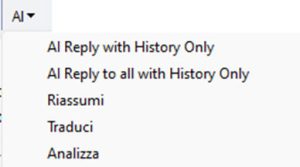
(I’ve developed this solution in Italan , so the translations are: Riasssumi = Summarize , Traduci = Translate,Analizza = Analyze )
When one of the two Reply actions is selected, an additional prompt is displayed, offering a further level of choice.
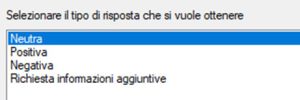
(Here you don’t need translationsf or the 3 elements at the top while Richiesta Informazioni aggiuntive = Request for additional information )
It is therefore possible to ask ChatGPT to generate the email reply using a different tone and style, depending on the type of message the user wants to produce. In other cases—such as summarization, translation, or content analysis—no additional prompts are shown, and the AI is queried directly on the email text.
From this point onward, everything depends on the quality of the prompts configured in DominoIQ. For example, the prompt associated with the Translate action is defined as follows:
“Identify the language of the provided message and then translate it into Italian.”
For the Analyze action, the prompt becomes:
“Analyze the provided email conversation in Italian, evaluating its importance or whether it should be considered spam. Respond with a professional tone, suggesting any actions to take or whether the email can be ignored.”
This approach clearly shows that the real value of the integration lies not only in the chosen AI engine, but above all in the ability to design effective prompts that are consistent with the business processes being supported or automated.
I refer you to a future article I will write on the details of the code used for this implementation.


0 Comments